





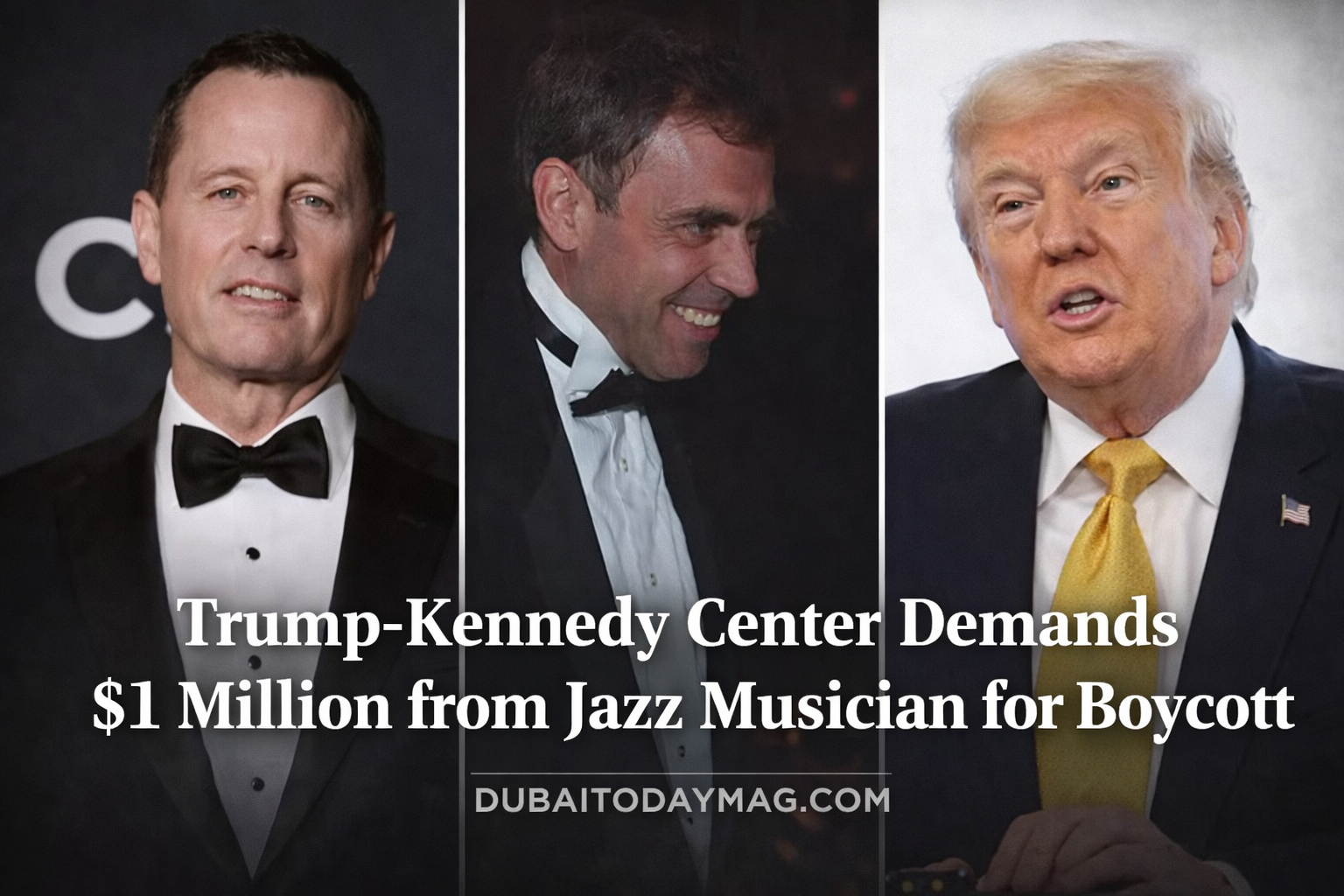
The newly renamed Trump-Kennedy Center is threatening legal action against jazz musician Chuck Redd after he canceled his Christmas Eve performance to protest the controversial name change honoring President Donald Trump. The center is demanding $1 million in damages.
Chuck Redd Cancels Kennedy Center Performance in Protest
Chuck Redd, a 67-year-old vibraphonist and drummer, made headlines on December 24, 2025, when he canceled his scheduled appearance at the Kennedy Center’s Christmas Eve Jazz Jam.
The veteran musician told The Associated Press and CNN that he withdrew from the performance “when I saw the name change” taking place at the historic Kennedy Center.
This wasn’t just any cancellation – it was a direct political statement against the institution being renamed to honor President Donald Trump.
For nearly 20 years, Chuck Redd had been leading the Christmas Eve Jazz Jam at the Kennedy Center. His sudden withdrawal sent shockwaves through Washington’s arts community.
Richard Grenell Threatens $1 Million Lawsuit
Richard Grenell, the Trump-Kennedy Center President, responded swiftly with a threatening letter to Chuck Redd on December 26, 2025.
The letter, published by The Associated Press and The New York Times, accused Redd of a “political stunt” and threatened to “seek $1 million in damages” from the musician.
Grenell’s letter stated:
“Your decision to withdraw at the last moment — explicitly in response to the Center’s recent renaming, which honors President Trump’s extraordinary efforts to save this national treasure — is classic intolerance and very costly to a non-profit Arts institution.”
The massive financial threat against a working jazz musician sparked immediate controversy and backlash.
What Richard Grenell Accused Chuck Redd Of
Richard Grenell’s letter to Chuck Redd contained several serious accusations about the musician’s motivations and actions.
Grenell claimed:
Falling for “bullying tactics”: He accused Redd of giving in to “sad bullying tactics employed by certain elements on the left, who have sought to intimidate artists into boycotting performances”
Political intolerance: Called Redd’s decision “classic intolerance”
Financial harm: Alleged the cancellation “has cost us considerably”
Being a “political performer”: Suggested Redd put politics above art
Causing pressure tactics: Said the center “will not yield to the pressure tactics being directed at us from political performers on our stages”
The letter concluded with a pointed message:
“True artists perform for everyone regardless of the political affiliation of audience members.”
This statement suggests real artists shouldn’t let politics influence their performances.
Grenell Claims Jazz Jam Had Low Attendance Anyway
In what seems like a contradictory argument, Richard Grenell’s letter also claimed that Chuck Redd’s Jazz Jam wasn’t actually that popular.
According to Grenell, attendance for the Jazz Jam, which Redd had led for nearly 20 years, had been “lagging considerably behind our other Christmas and holiday offerings.”
This raises an obvious question: If the show wasn’t well-attended anyway, why would its cancellation cause $1 million in damages?
The inconsistency in Grenell’s argument didn’t go unnoticed by critics.
Richard Grenell’s Social Media Response
Richard Grenell took his criticism of Chuck Redd to social media, posting on X (formerly Twitter) on December 26, 2025.
Sharing the New York Post’s coverage, Grenell wrote:
“The left is boycotting the Arts because Trump is supporting the Arts. But we will not let them cancel shows without consequences. The Arts are for everyone – and the Left is mad about it.”
This framing positions the controversy as “the left” attacking Trump rather than artists protesting a political name change.
Who Is Chuck Redd?
Chuck Redd isn’t just some random musician who decided to make a political statement – he’s a respected jazz artist with a decades-long career.
Chuck Redd’s impressive background:
Born: Maryland
Career start: Late 1970s
Early partnership: Drummed for legendary bossa nova guitarist Charlie Byrd for 19 years
Presidential performance: Played at the White House for President Jimmy Carter’s state dinner in 1981, alongside Barney Kessel
Teaching: Former University of Maryland faculty member
Collaborations: Performed with jazz legends including:
- Dizzy Gillespie
- Ray Brown
- Mel Tormé
Touring career: Over 40 years as a traveling musician
Recent work: Released album “Groove City” in 2019
Kennedy Center tradition: Led Christmas Eve Jazz Jam for nearly 20 years
This is a serious, accomplished musician with deep ties to Washington’s arts scene.
The Controversial Kennedy Center Name Change
The controversy began on December 18, 2025, when the Kennedy Center’s board of trustees voted to rename the institution.
The new official name:
Donald J. Trump and the John F. Kennedy Memorial Center for the Performing Arts
Previously, it was simply the John F. Kennedy Center for the Performing Arts, honoring the assassinated 35th President.
Why this is controversial:
Breaking tradition: Presidential centers typically aren’t named until after a president leaves office or dies
Living president: Trump is still alive and currently serving as president
Political division: Trump is an extremely polarizing figure
Kennedy legacy: Some see it as diminishing JFK’s memorial
Democratic opposition: Kennedy was a Democrat; Trump is a Republican
Timing questions: The quick name change raised eyebrows
The decision sparked immediate backlash from artists, politicians, and the public.
Joyce Beatty’s Federal Lawsuit Against Name Change
The Trump-Kennedy Center name change didn’t just face protests – it’s now in federal court.
On December 22, 2025, U.S. Representative Joyce Beatty (Democrat from Ohio) filed a federal lawsuit challenging the board’s decision to rename the Kennedy Center.
Potential legal arguments:
Congressional approval required: The Kennedy Center was established by Congress in 1958
Federal property issues: The center sits on federal land
Nonprofit regulations: Questions about proper governance procedures
Legacy protection: Arguments about honoring Kennedy’s memory
Political misuse: Concerns about using federal institution for political purposes
The lawsuit’s outcome could determine whether the name change stands.
Trump Appoints Political Allies to Kennedy Center Board
In February 2025, President Trump made dramatic changes to the Kennedy Center leadership.
Trump’s actions:
Became chairman: Trump announced he would be the “amazing” chairman himself
Replaced David Rubenstein: The billionaire philanthropist was removed as chairman
“Immediately” fired trustees: Trump terminated several existing board members
Appointed political allies: Installed loyalists in key positions
New Trump-appointed board members include:
- Usha Vance (Second Lady, wife of VP JD Vance)
- Pam Bondi (U.S. Attorney General)
- Pamella Roland DeVos (Fashion designer)
- Lee Greenwood (Singer of “God Bless the USA”)
- Laura Ingraham (Fox News host)
- Susie Wiles (White House Chief of Staff)
- Richard Grenell (Former acting director of national intelligence)
These appointments stacked the board with Trump supporters who would approve the name change.
Who Is Richard Grenell?
Richard Grenell, the man threatening Chuck Redd with a lawsuit, is a longtime Trump loyalist.
Grenell’s background:
Trump’s first term: Served as acting director of national intelligence
Diplomatic service: Former U.S. Ambassador to Germany
Political affiliation: Strong conservative and Trump defender
Current role: President of the Trump-Kennedy Center
Known for: Aggressive political tactics and social media presence
Controversial figure: Has faced criticism for various statements and policies
Grenell’s appointment as Kennedy Center president signaled a more politically aggressive approach to running the arts institution.
Trump’s Kennedy Center Honors Hosting
On December 7, 2025, President Trump became the first sitting president to host the Kennedy Center Honors ceremony.
What happened at the event:
Lavished praise on honorees: Trump complimented medal recipients including:
- Sylvester Stallone (Rocky actor)
- Gloria Gaynor (“I Will Survive” singer)
- Gene Simmons, Paul Stanley, and Peter Criss (KISS band members)
Made insulting comments: Trump reportedly looked at some attendees and said “I just hate” certain people
Mixed tone: The event combined celebration with Trump’s typical controversial style
This event foreshadowed the coming name change controversy.
The “Political Stunt” Accusation
Richard Grenell calling Chuck Redd’s cancellation a “political stunt” raises interesting questions about art and politics.
Arguments that it IS a political stunt:
- Redd explicitly cited the name change as his reason
- Timing close to Christmas maximized publicity
- Created media attention and controversy
- Could be seen as grandstanding
Arguments that it’s legitimate protest:
- Artists have the right to choose where they perform
- Protesting government actions is fundamentally American
- Redd gave up income and a 20-year tradition
- Real consequences show it’s not just for show
- Political expression is protected free speech
Whether it’s a “stunt” or genuine protest depends on your perspective.
Can Kennedy Center Actually Win $1 Million?
The threat of $1 million in damages sounds dramatic, but can the Trump-Kennedy Center actually collect this money?
Legal questions:
Contract breach: Did Redd have a contract requiring performance?
Actual damages: Can the center prove $1 million in losses?
Reputation harm: Is the claim about financial or reputational damage?
Free speech defense: Does Redd have First Amendment protections?
Proportionality: Would courts award such a massive sum?
Intimidation tactics: Is this a SLAPP suit (Strategic Lawsuit Against Public Participation)?
Most legal experts would likely say collecting $1 million from a jazz musician for canceling one performance would be extremely difficult, if not impossible.
The Larger Artist Boycott Movement
Chuck Redd isn’t the only artist protesting the Trump-Kennedy Center name change.
Growing boycott concerns:
Multiple artists have expressed discomfort performing there
Some have quietly withdrawn from future bookings
Others have made public statements against the name change
Arts organizations are debating whether to partner with the center
Donors may reconsider financial support
The Kennedy Center faces potential long-term damage to its reputation
Grenell’s letter acknowledged these concerns, referring to “certain elements on the left, who have sought to intimidate artists into boycotting performances.”
Free Speech vs. Contracted Performance
This controversy highlights the tension between free speech rights and contractual obligations.
Free speech perspective:
- Artists can choose where to perform
- Political protest is protected expression
- No one should be forced to associate with political figures they oppose
- Boycotts are a legitimate form of protest
Contract perspective:
- Agreements should be honored
- Last-minute cancellations harm organizations
- Professional commitments matter
- Politics shouldn’t interfere with art
The middle ground:
- Artists should give reasonable notice
- Contracts should include cancellation terms
- Political disagreement doesn’t absolve all responsibility
- But threats of massive lawsuits chill free expression
The legal and ethical balance is complicated.
What “True Artists Perform for Everyone” Really Means
Richard Grenell’s statement that “true artists perform for everyone regardless of the political affiliation of audience members” sounds reasonable but deserves examination.
The argument FOR this position:
- Art should transcend politics
- Artists serve the public, not politicians
- Avoiding partisan institutions limits artistic reach
- Great artists have performed for controversial leaders throughout history
The argument AGAINST this position:
- Artists have always made political choices
- Performing at a Trump-named venue IS a political statement
- “Everyone” doesn’t include the government officials who renamed the building
- Artists have refused to perform for controversial figures throughout history
- Choosing where you perform is part of artistic freedom
The idea that art and politics can be completely separated is historically questionable.
The Kennedy Family’s Perspective
While not mentioned in the current reporting, the Kennedy family presumably has strong feelings about the Trump name being added to JFK’s memorial center.
Potential Kennedy family concerns:
Legacy dilution: JFK’s memorial now shares billing with Trump
Political opposition: Most Kennedys are Democrats who oppose Trump
Historical significance: JFK was assassinated; this was HIS memorial
Family consultation: Were Kennedys consulted about the change?
Public perception: How does this affect JFK’s memory?
The Kennedy family has not issued public statements, but the silence is notable.
Nonprofit Status and Political Activity
The Kennedy Center is a nonprofit organization, which raises questions about political activity.
Nonprofit regulations:
501(c)(3) status: Nonprofits must serve educational/charitable purposes
Political activity limits: Excessive political involvement can jeopardize tax-exempt status
Naming rights: Questions about whether adding a sitting president’s name is appropriate
Board composition: Having White House staff and political appointees as trustees is unusual
Mission drift: Is the center still serving its original arts mission?
The IRS and Congress could potentially investigate these concerns.
Impact on Working Musicians
The threat against Chuck Redd has broader implications for working musicians and artists.
Why this matters for artists:
Financial intimidation: $1 million threat could bankrupt most musicians
Chilling effect: Other artists may fear boycotting out of lawsuit concerns
Power imbalance: Wealthy institutions vs. individual artists
Political pressure: Artists feel forced to perform despite objections
Career consequences: Speaking out could mean blacklisting
Moral choices: Artists must weigh principles against practical needs
The case could set precedents affecting how artists engage with controversial institutions.
Public Reaction and Divided Opinion
Public reaction to the Chuck Redd vs. Trump-Kennedy Center controversy is sharply divided along political lines.
Conservative perspective:
- Redd broke a commitment unprofessionally
- The left is trying to “cancel” everything Trump-related
- Arts institutions should be politically neutral
- Last-minute cancellations harm audiences and organizations
Liberal perspective:
- Artists have the right to protest unjust name changes
- Threatening a $1 million lawsuit is bullying and intimidation
- The Kennedy Center was politicized first by adding Trump’s name
- Supporting Redd’s principled stand against authoritarianism
Middle ground:
- Both sides have some valid points
- Better communication could have avoided this mess
- The real issue is the controversial name change itself
- Lawsuits seem disproportionate and counterproductive
What Happens Next?
The Trump-Kennedy Center vs. Chuck Redd controversy is still developing.
Possible outcomes:
Lawsuit actually filed: Grenell follows through on the threat (seems unlikely)
Quiet resolution: The threat was just intimidation; nothing happens
Public pressure: Backlash forces the center to back down
More boycotts: Other artists join Redd in protesting
Legal settlement: Joyce Beatty’s lawsuit affects the situation
Name change reversal: Courts or Congress force the name back to just Kennedy
Trump administration pressure: Government influence on the situation
Arts community response: Organizations take sides publicly
The coming weeks will reveal whether this was an empty threat or the beginning of a serious legal battle.
Conclusion: Arts, Politics, and Power
The Trump-Kennedy Center demanding $1 million from Chuck Redd for canceling a Christmas performance represents a collision between art, politics, and power that will resonate far beyond one jazz musician’s decision.
At its heart, this controversy asks fundamental questions:
Should artists be forced to perform at politically controversial institutions? Can nonprofits threaten massive lawsuits against individuals who disagree with their political decisions? Is it appropriate to rename national cultural treasures after living, polarizing political figures? Where’s the line between professional commitment and political conscience?
Chuck Redd, a 67-year-old jazz musician who’s led Christmas performances for 20 years, made a choice based on principle. Whether you view it as a “political stunt” or legitimate protest depends largely on your political perspective.
Richard Grenell’s response – threatening $1 million in damages – seems designed more to intimidate other potential protesters than to actually collect money from a working musician.
As the Kennedy Center navigates its controversial transformation into the Trump-Kennedy Center, it faces a fundamental identity crisis: Can a national arts institution named after a divisive political figure truly serve all Americans?
The answer will emerge not in legal threats, but in whether artists choose to perform there and audiences choose to attend.
Read More : Sheikh Hamdan and Elon Musk Explore Global Tech Partnerships
